





What is really ruining your sleep and how to help yourself
Share
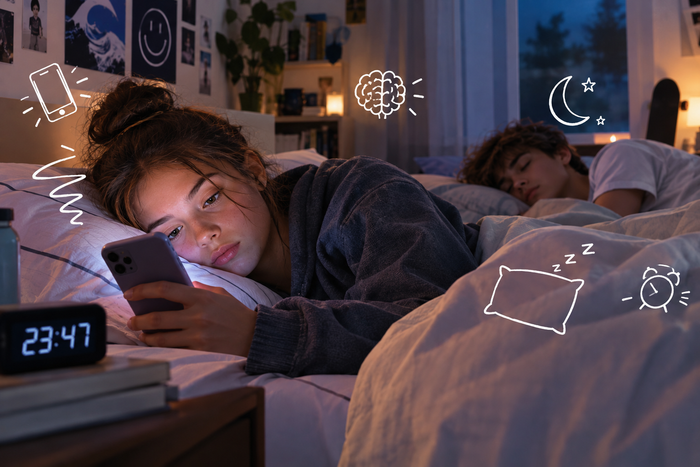
"I go to bed at 11:00 PM, but I don't fall asleep until 1:30 AM" is a sentence almost every teenager has said at least once. The good news: this is neither stubbornness nor a bad routine - there is a real biological mechanism behind it. The bad news: what you do in the hours before bed either compensates for the problem or makes it drastically worse.
Why your body literally doesn't want to fall asleep early
During puberty, something happens that few people are aware of - the brain starts releasing melatonin (the hormone that tells the body "it's time for sleep") later in the evening than it does in children or adults. This is a biological shift in the internal clock, known as "delayed sleep phase." That is why at 15-16 years old, it is completely normal not to feel sleepy at 10:00 PM, even if you are tired - your body physically cannot fall asleep.
Screens make things even worse
The problem is that during the very hours when the brain should start producing melatonin, most teenagers are looking at exactly what blocks it. The blue light from phones, tablets, and TVs suppresses melatonin secretion and further delays the moment when you actually feel sleepy, which means falling asleep even later and getting even less sleep before school. That is why doctors recommend at least an hour without screens before bedtime. Not because "it's a good idea," but because it actually helps reset your body's rhythm.
"Catching up" on Saturday doesn't work
A common tactic is to go to bed late during the week and "catch up" on sleep on Saturday and Sunday. The problem is that this pushes your internal clock even further back and makes falling asleep on Sunday night even harder. A better approach is to wake up at approximately the same time every day, including on weekends. We know it's hard...
Small tips
You don't need a complicated plan - it is important that the body receives the same signals every night:
- Screens off at least an hour before bed - instead, try reading, music, or talking.
- Avoid caffeine and intense workouts at least 4 hours before sleep.
- A cool, dark, and quiet room - the environment matters almost as much as your habits.
- Light, repetitive actions before bed (washing your face, brief stretching, writing a few lines in a journal) - the body associates these actions with "I'm going to bed."
Why this isn't "just sleep"
Sleep deprivation doesn't just stay in your head - it is linked to poorer concentration, lower serotonin, and consequently, a worse mood. In other words, quality sleep is not a luxury, but the foundation upon which everything else rests - mood, concentration, and even the condition of your skin.
Sources:
- Children's Hospital of Richmond / Dr. Justin Brockbank - Is Your Teen Getting Their Eight Hours?
- AJMC - What Factors Contribute to Sleep Disorders in Adolescents? (Dr. Sujay Kansagra, Pediatrics)
- CHOC / Dr. Eric Ball - CHOC Pediatrician Talks Adolescent Sleep Hygiene
- Sydney Children's Hospitals Network - Sleep Recommendations for Teenagers (13+)
- MDedge / Dr. Spinks-Franklin - Helping Adolescents Get Enough Quality Sleep
- Community Medical Centers - Why Sleep Is So Important for Teens